
Crystal Instruments has published a case study showing how distributed, GPS-synchronised data acquisition helped a major aerospace contractor at Cape Canaveral understand why windows in a launch support building were cracking. THP Systems represents Crystal Instruments in the UK, and the lessons apply to any large structure exposed to short, intense events.
The problem
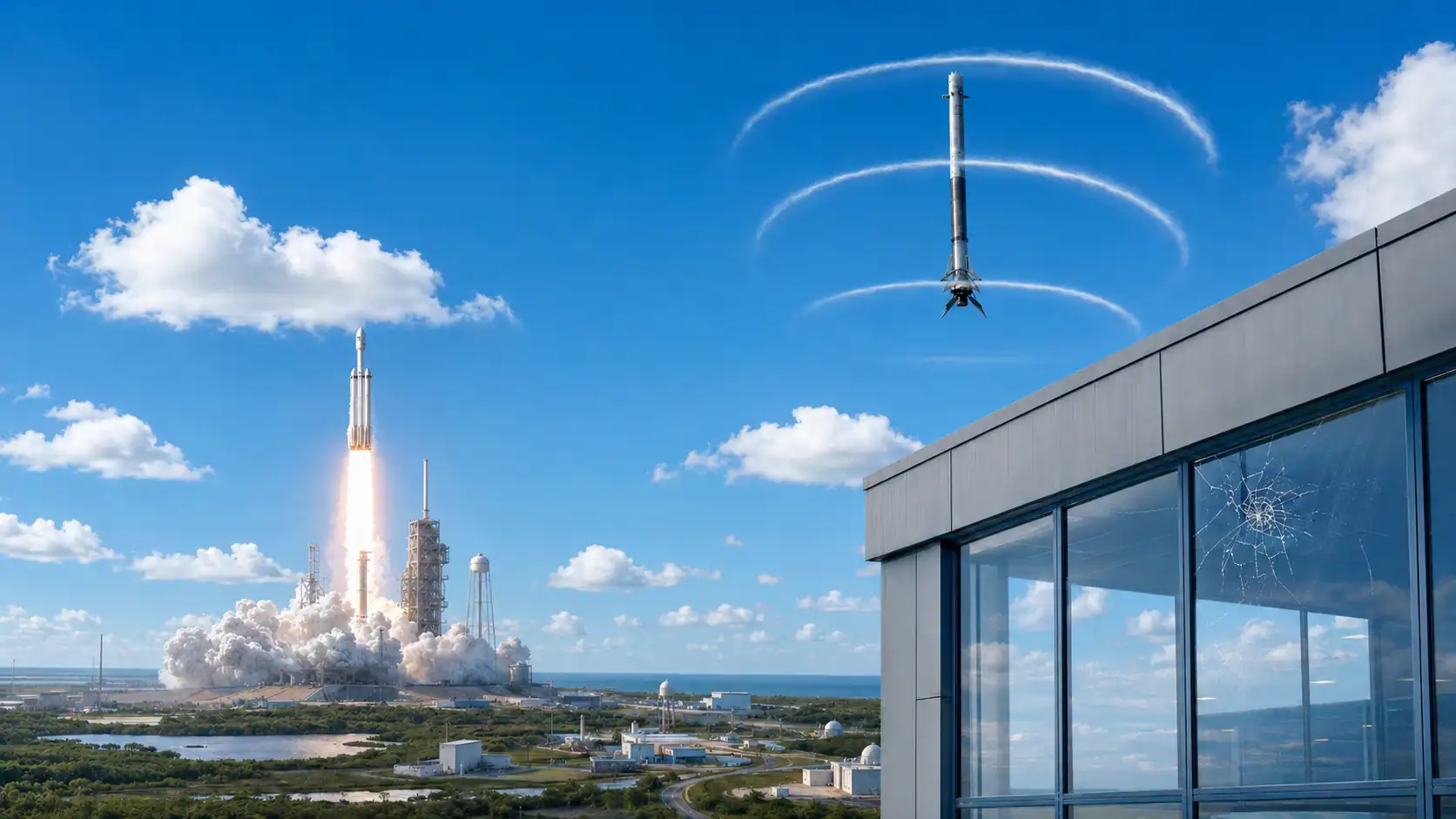
Reusable boosters now return to land, and on the way down they go supersonic again, producing three distinct sonic booms below 3 Hz from the nose, base and grid fins. A roughly 60,000 sq ft building about two miles from launch complex SLC-36 began to show cracked windows, with cracks that kept growing and tracked with launch and landing activity, yet no data had ever been recorded during those events.
The challenge was clear: the landing impulse lasts a fraction of a second, the structure spans hundreds of feet, and every channel needs a shared, trusted clock.
First attempt: separate recorders
An initial campaign used three 8-channel CoCo-80X handheld recorders. It proved the problem was real, but the units had to be started and left before the exclusion zone was activated, with no remote control. Each had its own clock, so channels were aligned by hand in spreadsheets afterwards. Crystal Instruments has since added GPS capability to the CoCo-80X in response.
The solution: Spider-80Xi with GPS time sync
The customer moved to the Spider-80Xi distributed data acquisition platform. Each chassis carries its own clock and can lock to GPS to better than 60 ns, so separate buildings can share one timeline without cabling between them. Chassis on a shared Spider-HUB synchronise over IEEE 1588v2 to better than 100 ns, with phase match within ±1° at 20 kHz.
A 32-channel system run from one control point captured accelerometers on the roof, windows and doors alongside free-field microphones. Data was aligned at the moment of recording, so analysis started the same day.
What the data showed
According to Crystal Instruments, measured levels were roughly “an order of magnitude higher than the launch provider’s published prediction”, a result supported by an independent acoustics analysis. The data also showed real variation in response across the building.
Scaling up
The programme has grown to six systems and 224 channels, extending to a second, 130,000 sq ft facility about three and a quarter miles from the SLC-36 and SLC-40 landing sites, with a permanent rack-mounted installation planned. The customer standardised on one building block: a Spider-80Xi chassis with four 8-channel IEPE cards. For even higher channel counts, the new Spider-80Hi front-end scales Spider-80Xi systems up to 1,024 channels.
For UK aerospace and defence sites facing similar questions, THP can configure Spider systems with time waveform recording and acoustic analysis.
Source: Crystal Instruments
To discuss a distributed measurement project, please contact the THP team.