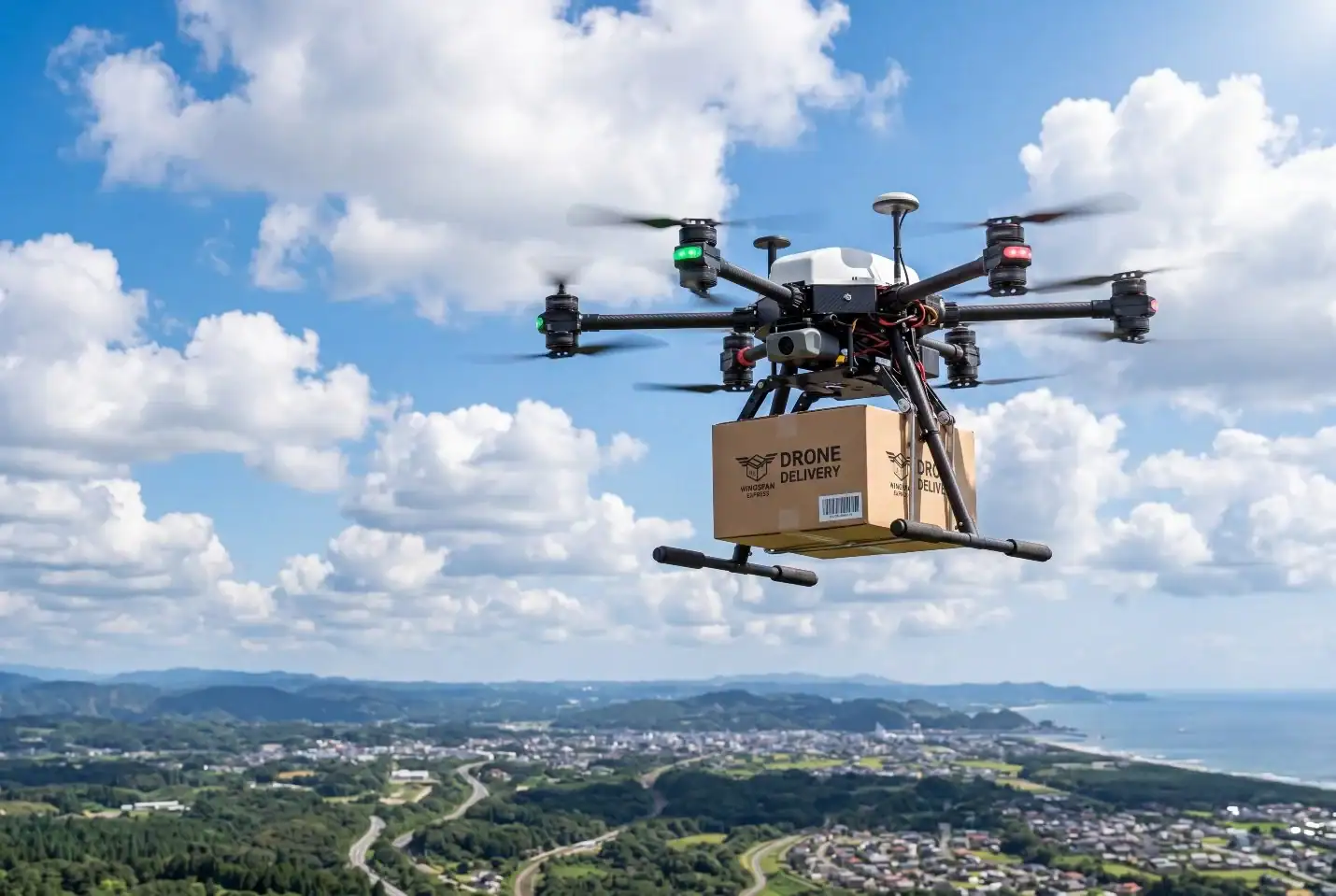
Crystal Instruments has published an application note on vibration testing package delivery drones using its Spider-81 vibration controller with Sentek Dynamics electrodynamic shakers. With UK interest in drone logistics growing, THP Systems has summarised the approach for engineers working on unmanned aircraft and their sub-systems.
Why drones need vibration qualification
Delivery drones are light, but they see a demanding mix of loads through their lives: motor and propeller excitation, manoeuvres and turbulence, landing impacts, road transport and shipping, and thousands of repeated missions. Typical results include connector failures, cracked solder joints, sensor calibration drift, battery mount fatigue, structural cracks, loose fasteners, wear in payload release mechanisms and degraded IMU or GPS performance. Finding these problems in the lab is far cheaper than finding them in service.
Engineers can test a complete drone or isolate items such as flight controllers, navigation electronics, cameras, battery packs, landing gear, communication modules and even shipping packaging using suitable fixtures.
The role of the Spider-81
The Spider-81 measures accelerometer responses and adjusts shaker drive in real time to hold the required profile. It uses embedded DSP control with time-synchronised Ethernet, can run independently of the host PC in Black Box mode, and accepts IEPE, TEDS, charge and voltage sensors. Its distributed design with IEEE 1588 synchronisation means a small system can grow into a much larger synchronised one.
Typical drone tests
- Random vibration to represent broadband flight and transport environments, with closed-loop control of the target PSD
- Swept sine and resonance search and dwell to locate resonances and improve mountings
- Classical shock for hard landings, transport drops and handling
- Time waveform replication to play back vibration recorded during real flights, reducing the need for repeated outdoor testing
The controller also supports sine-on-random, random-on-random and shock response spectrum testing. Multi-channel measurement lets teams monitor motor mounts, battery trays, the flight controller, camera gimbal, landing gear and payload bay together while controlling from one reference point.
From development to production
The same set-up serves R&D (comparing prototypes and validating finite element models), design verification, production acceptance testing and failure investigation, where measured field environments can be recreated to find root causes.
Spider controllers work with a wide range of electrodynamic and hydraulic shakers. In the UK, THP supplies them as standalone upgrades or as complete systems, and supports aerospace customers through specification, installation and training.
Source: Crystal Instruments
If you are planning a drone or UAV qualification programme, please contact the THP team to discuss controller and shaker options.